FASTag
View recent toll plaza transactions for a vehicle.
This tool lists the toll plazas a vehicle passed through in the last 72 hours - plaza name, exact time, lane direction and the vehicle class the plaza recorded - using the same NETC feed the toll operators use.
It runs a pending-challan check alongside, so a fleet manager or buyer sees toll activity and outstanding fines for the same vehicle in one view.
What is FASTag?
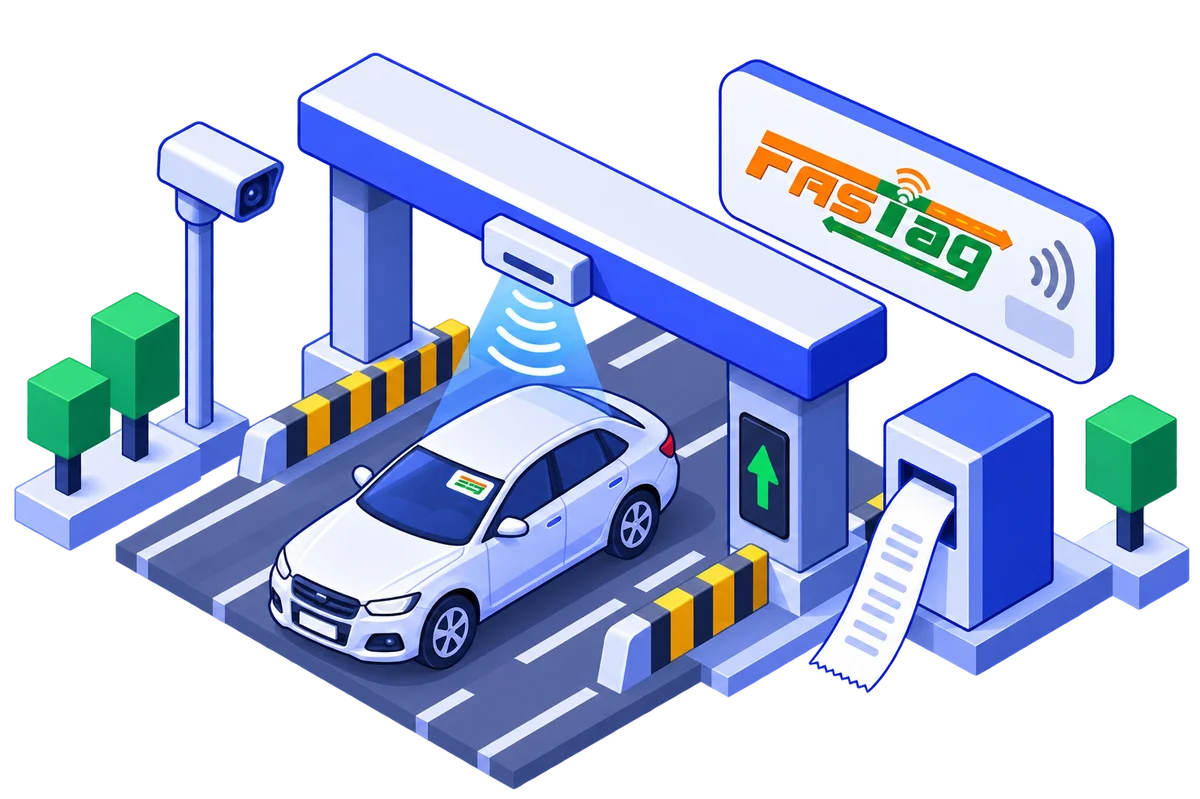
FASTag is India's electronic toll collection programme, run by the National Highways Authority of India (NHAI) through its subsidiary IHMCL and settled by the National Payments Corporation of India (NPCI) under the National Electronic Toll Collection (NETC) scheme. A FASTag is a passive RFID sticker fixed to the inside of the windscreen; when the vehicle drives through a toll lane, an overhead reader identifies the tag, and the toll is debited from the prepaid wallet or bank account linked to it - no stopping, no cash.
The tag was piloted on the Ahmedabad-Mumbai highway in 2014 and rolled out nationally over the following years. It became mandatory for all M and N class vehicles (cars, jeeps, vans, buses, trucks) on National Highway fee plazas from 1 January 2021 (the Ministry of Road Transport and Highways moved the date from December 2020). Plazas now run "FASTag-only" lanes, and a vehicle without a valid, readable tag pays double the applicable fee in cash.
Since 1 April 2024 NHAI enforces "One Vehicle, One FASTag": a single tag per vehicle, linked to its registration number and KYC, with duplicate or transferred tags deactivated. From 15 August 2025 private cars, jeeps and vans can also buy a FASTag Annual Pass (₹3,000 for 200 plaza crossings or one year, whichever comes first) valid at roughly 1,150 NH and expressway plazas.
How a toll passage is recorded
Every FASTag carries a Tag ID (TID) and an EPC that encodes the vehicle class and issuing bank. The plaza's RFID reader (ISO 18000-6C / EPC Gen2, 865-868 MHz) reads the tag at a few metres, the lane controller matches it against NPCI's mapper, and an ANPR camera captures the plate as a second check. The result is the transaction record this tool shows: reader time, plaza, lane direction, vehicle class and the vehicle number the tag is mapped to.
The toll operator's acquirer bank sends the debit request to NPCI, which routes it to the issuer bank that sold the tag. Settlement between banks happens in NETC's daily cycles, which is why the balance on your FASTag app can lag the passage by a few hours. The 72-hour transaction feed is what NETC exposes to authorised consumers such as ULIP; it is a passage log, not a statement, so amounts are not included here.
- 1
Tag read
The lane antenna reads the tag's TID and EPC as the vehicle approaches; the ANPR camera photographs the number plate.
- 2
Validation
The lane controller checks the tag against the NPCI mapper - is it active, not blacklisted, and mapped to this vehicle class?
- 3
Debit request
The acquirer bank raises the toll request through NPCI to the issuer bank, which debits the linked wallet or account.
- 4
Barrier lifts
On approval the boom rises and the passage is written to NETC with plaza, lane, time and class.
- 5
Settlement
NPCI nets the day's transactions between banks; the passage appears in the 72-hour feed within minutes, the SMS from your bank a little later.
How to check with FASTag
- 1
Enter the vehicle number
The registration number linked to the FASTag, without spaces - MH12AB3456.
- 2
Check
The lookup queries NETC for the last 72 hours of passages and, in parallel, the challan registry for pending fines.
- 3
Read the timeline
Passages are grouped by day, newest first, with each plaza plotted on the map. Open a plaza to see its direction and class; expand to see all passages.
Why check a vehicle's toll history
Prove where a vehicle was
A plaza passage is a time-stamped, independently recorded fact. Fleet owners use it to verify trip sheets, insurers and lawyers use it to corroborate an incident timeline.
Catch wrong-class deductions
Toll depends on the vehicle class encoded in the tag. If a car is being charged as an LCV (VC5 instead of VC4) it shows here before it shows on the bill.
Spot tag cloning or misuse
Passages at plazas the vehicle never visited point to a tag used on another vehicle - grounds to ask the issuer to blacklist and reissue.
Pre-purchase due diligence
Together with the pending-challan check, recent toll activity tells a used-vehicle buyer whether the car has been in daily use and whether fines are outstanding.
Reading the result
Each row is one passage as NETC recorded it. The summary tiles roll the list up.
- Passages · 72 h
- Number of plaza crossings in the window and how many distinct plazas were involved. A return trip on one highway typically shows each plaza twice.
- Last seen
- The most recent passage, as a relative time and the exact reader timestamp with the plaza name.
- Vehicle class
- The NETC class encoded in the tag (VC4 car/jeep/van, VC5 LCV, VC6-VC7 bus/truck 2-3 axle, VC8+ multi-axle). If this does not match the vehicle, the tag was issued for the wrong class.
- Pending fines
- Total outstanding traffic challans for the same number from the eChallan registry; click through for the individual challans.
- Time
- Reader read time at the plaza, local time, from the lane controller's clock.
- Toll plaza
- The fee plaza name as registered with NHAI/NETC. State-highway and municipal plazas that are on NETC also appear.
- Direction
- The lane's traffic direction as configured at the plaza (Northbound, Southbound...). Useful to tell outbound from return legs.
- Seq
- The transaction sequence number assigned by the plaza system - quote it to the issuer bank when disputing a deduction.
- Route map
- Plazas with published coordinates plotted in time order; numbered pins run oldest to newest, so the dashed line traces the journey.
Example input
MH12AB3456
Two-letter state code, two-digit RTO, series letters, four-digit number - exactly as printed on the plate, no spaces or hyphens.
Who uses it
Trip expense reconciliation
Match toll passages against a trip sheet to reconcile fuel and travel claims for a business trip or a fleet vehicle.
Verifying an unexpected deduction
Confirm a deduction you do not recognise by checking exactly which plaza, lane and time it was recorded at.
Rental and fleet handover
Rental agencies and fleet operators check a returned vehicle's toll activity before settling the driver's account.
Route compliance
Transport managers confirm a consignment took the assigned highway by reading the sequence of plazas it crossed.
Common problems
No passages found although the vehicle used a toll road
The feed only covers the last 72 hours, and only NETC-enabled plazas. Check the number for typos and that it is the number the tag is mapped to - a tag moved between vehicles reports the original registration.
Deducted twice for one crossing
Double debits happen when a lane retries a read. Note the Seq numbers of both entries and raise a chargeback with your issuer bank through the FASTag app or by calling 1033; NPCI's dispute window is 30 days.
Charged at a plaza I never crossed
Possible tag cloning or a mis-mapped vehicle number. Ask the issuer to blacklist the tag and issue a new one; keep this passage list as evidence.
Class shown is wrong for my vehicle
The class is fixed at issuance from the RC. If the RC says LMV but the tag reports VC5, the issuer must reissue the tag; until then every crossing is overcharged.
Tag read but barrier did not open
Usually a blacklisted tag (low balance, KYC pending, or duplicate tag under One Vehicle One FASTag). Recharge or complete KYC in the issuer app; a plaza cannot fix this at the lane.
Frequently asked questions
Glossary
- NETC
- National Electronic Toll Collection - the NPCI scheme that clears FASTag transactions between toll operators and issuing banks.
- IHMCL
- Indian Highways Management Company Limited, the NHAI subsidiary that runs the FASTag programme and the 1033 helpline.
- Issuer bank
- The bank or payments company that sold the tag and holds the linked wallet; disputes go to them.
- Acquirer bank
- The bank that services the toll plaza and raises the debit request.
- TID / EPC
- The tag's hardware identifier and the programmable code that carries vehicle class and issuer details.
- Vehicle class (VC)
- NETC's toll category: VC4 car/jeep/van, VC5 LCV, VC6-VC7 2-3 axle bus/truck, VC8-VC10 multi-axle, VC11+ oversized.
- Blacklist
- A tag status that blocks passage - set for low balance, incomplete KYC, or a duplicate tag.
- ANPR
- Automatic Number Plate Recognition - the camera check that pairs a tag read with the plate in the lane.